During the practical boat license exam, they make you tie knots under time pressure while an examiner stares at your hands with a clipboard.
You stand there sweating over sheet bends, anchor hitches, and figure eight loops, desperately trying to remember which rabbit goes around which tree. You pass the exam, breathe a sigh of relief, and step onto a real boat.
Then reality hits.
You approach a busy pontoon in a crosswind, your crew is waiting for instructions, the boat is drifting away from the berth, and your mind completely empties. Whether you are pulling up to a floating dock on Lake Como or mooring against a concrete quay in a choppy Ligurian marina, you do not need an encyclopedia of 25 decorative maritime knots. You need instant muscle memory on three.
After a season of docking, securing fenders, and watching seasoned Mediterranean skippers work without looking at their hands, here is the honest truth: master these three, learn to tie them in the dark, and forget the rest for now.
1. The Cleat Hitch (Nodo di bitta)
If you only learn one knot for the rest of your boating life, make it this one.
The cleat hitch secures your dock lines to the boat deck cleats and the marina dock cleats. It is the single thing preventing your boat from drifting across the bay while you are on shore having an espresso.
The biggest beginner mistake, and I made this constantly at first, is overwrapping. People panic about the boat moving with the Mediterranean swell and wrap the rope around the cleat twelve times like an Egyptian mummy. It looks messy, wastes line, and actually makes the knot harder to release quickly.
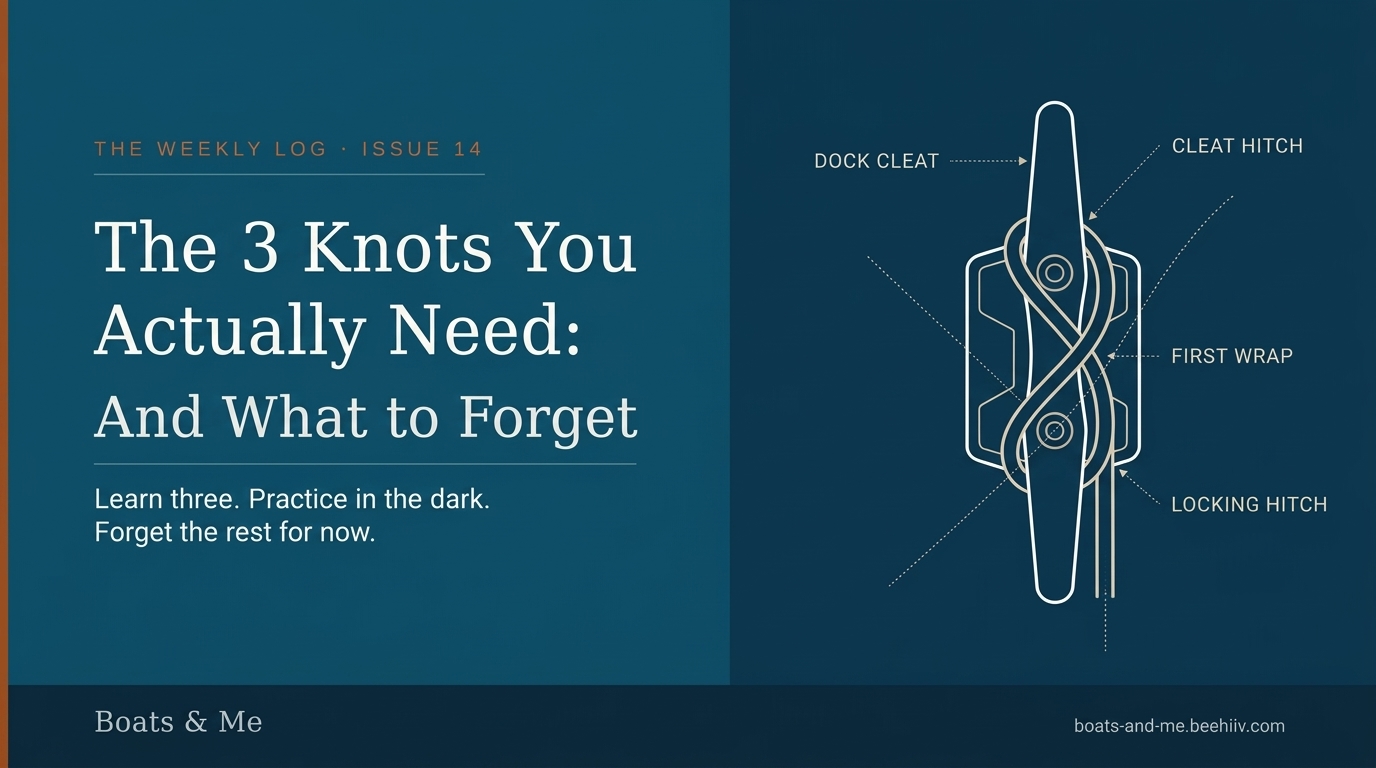
All a proper cleat hitch takes is three simple movements:
- First: One full turn around the base of the cleat to absorb the boat tension.
- Second: One neat figure eight across the horns.
- Third: One final half turn flipped over to lock it (mezzo collo di bloccaggio), where the free end sits neatly trapped under itself, parallel to the cleat horn.
That is it. Under heavy surge, it bites hard. When you return to cast off, it unties in two seconds without jamming.
2. The Bowline (Gassa d'amante)
Old sailors call the bowline the king of knots, and for once, the old sailors are not exaggerating.
The bowline creates a strong loop at the end of a line that will not slip. You use it to make a temporary loop to throw over a dock bollard, to secure an anchor rode to a shackle, or to rig a towing line.
What makes it magic in both lake and sea conditions is that no matter how hard the wind or tide pulls, a bowline will never slip. And even after spending hours drenched in Mediterranean saltwater under hundreds of kilos of tension, it never binds. You simply flip the collar back with your thumb to break its back, and it falls apart effortlessly.
The mnemonic about the rabbit coming out of the hole, around the tree, and back down into the hole is cheesy, but it works. Practice it until your fingers form the loop automatically without thinking about rabbits.
3. The Clove Hitch (Nodo parlato)
Every beginner has felt that sudden spike of panic watching an expensive fender come loose and bob merrily away into the sunset.
The clove hitch is the universal knot for attaching fenders (parabordi) to your lifelines, stanchions, or handrails. It allows you to adjust the fender height in seconds depending on whether you are tying up against a high stone quay or a low floating pontoon.
The catch is that on slick stainless steel rails, a bare clove hitch can slip under constant wave motion and boat roll.
The rule is simple: always finish your clove hitch with two half hitches (due mezzi colli) on the standing line. It takes three extra seconds and guarantees that your fender stays exactly where you set it when the boat starts rubbing against the dock.
The Knots You Can Forget For Now
The reef knot or square knot (nodo piano) is one every beginner learns first because it feels easy, and then tries to use it to join two mooring lines together. Do not do this. The reef knot was designed to bind sails when reefing (terzaroli), not to hold a load. Under cyclic wave tension or with slippery synthetic ropes, a nodo piano will capsize, jam solid, or slip apart completely. If you need to join two lines under load, use two interlocking bowlines instead.
The sheet bend (nodo di bandiera or nodo di scotta) is great for joining two ropes of different thicknesses. In normal recreational coastal or lake day boating, you will almost never do this.
The anchor bend (nodo d'ancorotto) is useful in theory for tying line directly to an anchor ring, but a proper stainless steel shackle seized with safety wire or a solid bowline does the job fine for day boaters.
The sheepshank (nodo Margherita) is used to shorten a line without cutting it. If you find yourself needing this on an 18 foot boat in a Mediterranean cove, something has already gone very strange.
Save your mental bandwidth. Master the big three first.
What I Still Need to Figure Out
Tying a cleat hitch when the water is flat calm is easy now. Tying it when there is a 15 knot chop bouncing the stern toward a concrete wall while someone on the dock is yelling at me in Italian to pass the line? That is still an adventure in pure adrenaline.
Muscle memory under calm conditions is not the same as muscle memory under pressure. My goal this month is to practice tying all three behind my back on the living room sofa until my fingers do not need my eyes to confirm the lock.
See you next Thursday.
— Ale
- Stop overwrapping cleats: One round turn, one figure eight, one locking hitch. Piling ten loops onto a bitta does not make it safer, it just makes it impossible to release quickly in an emergency.
- Always lock your clove hitches: Stainless steel rails are slippery, especially with salt spray. A plain nodo parlato will walk. Always back it up with two mezzi colli.
- Practice in the dark: If you have to look closely at your hands to tie a gassa d'amante, you are not ready to use it when unexpected weather rolls into the bay. Keep a one-meter piece of line on your desk.
When learning knots from a static book, 2D drawings are almost impossible to follow once lines cross. Animated Knots breaks down every marine knot step by step with clear interactive 3D photos you can scrub forward and backward. Plus their mobile app works 100% offline out in remote coves.
Visit animatedknots.com →This happens constantly at busy transit docks and lakeside restaurant pontoons during peak summer.
Never just lay your eye loop over someone else's line. If they need to cast off before you, they cannot untie their boat without undoing yours first.
Instead, use a technique called dipping the eye (passaggio della gassa dal basso): take the eye loop of your line and thread it up from underneath through the center of their eye before dropping it over the cleat horns. That way, either vessel can cast off at any time without disturbing the other. It is fundamental European maritime courtesy.