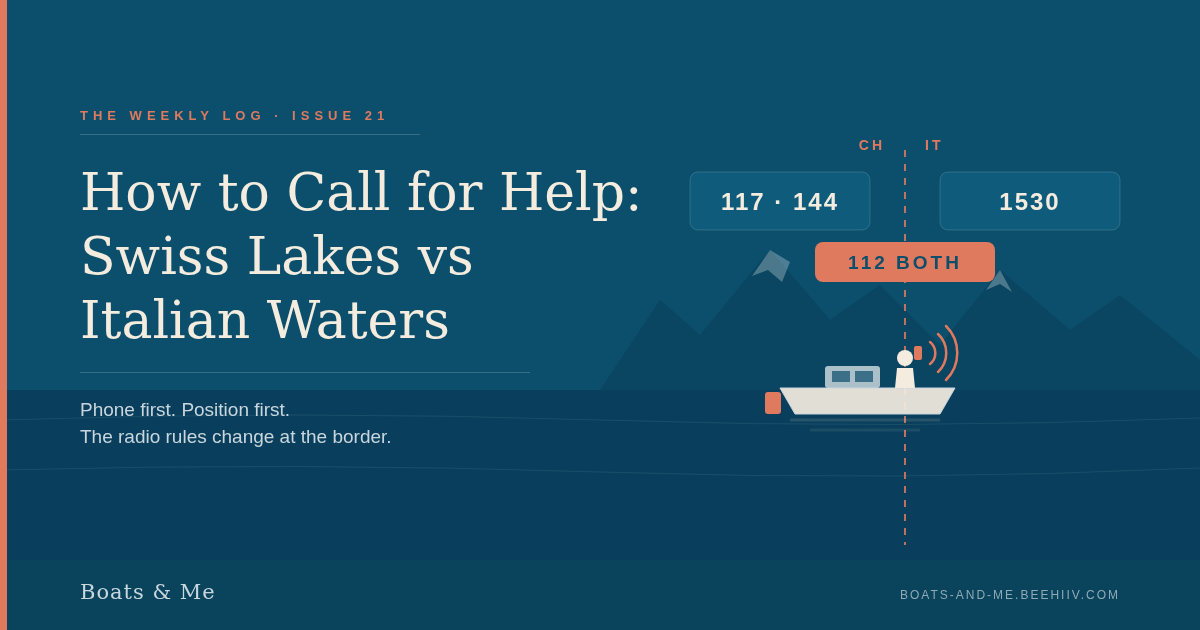
When you drive from Switzerland into Italy, the border is impossible to miss. There are physical booths, speed bumps, uniformed officers, and traffic cameras reminding you that you are entering another country.
When you do it by boat on Lake Lugano or Lake Maggiore, the border is completely invisible.
You are cruising on a sunny Sunday afternoon, looking at cypress trees along the shoreline. You glance down at your navigation app and realize the little arrow representing your hull just floated across a thin dotted line in the middle of the water. Just like that, while reaching into the cooler for a cold drink, you crossed an international frontier.
The first time this happened to me, a sudden wave of panic set in. Did I need a special flag flying from my stern? Was a patrol boat about to cut across my bow with sirens blaring? Was I committing an accidental international customs offense between Gandria and Oria?
Here is what I know so far about crossing water borders, assembled from official lake regulations, license theory, and conversations with captains who cross these lines every weekend.
The Schengen paradox: people vs goods
The most confusing part for beginners is understanding what border rules actually apply on the water.
Both Switzerland and Italy are part of the Schengen zone. That means passport controls for recreational movement are generally non existent. You do not need to show your passport just because your boat entered Italian waters.
However, Switzerland is not in the European Union customs union (unione doganale).
This distinction is everything. Your person is free to move, but your boat, your fuel, and any goods you carry are subject to strict customs laws. When authorities on the water stop you, they are rarely border guards checking visas. They are tax and customs authorities making sure you are not smuggling goods or evading import duties on the boat itself.
Innocent passage vs touching land
The single most important rule to remember as a beginner is the difference between navigating across the water and touching land.
If you are simply cruising across the line, swimming in a bay, or dropping anchor for lunch without going ashore, this falls under innocent passage (passaggio inoffensivo). You do not need to report to customs. You do not need prior authorization. You can cruise from the Swiss end of Lake Maggiore down into the Italian waters and head back before sunset without notifying anyone.
The moment your boat touches a dock, drops a passenger on a quay, or ties up to a restaurant pontoon on the other side, the game changes completely.
Once you touch land in the other country, you have made a formal entry (approdo). By law, your very first stop must be an official customs landing point (posto di approdo doganale) to declare goods or report your arrival. Tying up directly to an Italian lakeside pizzeria for lunch without clearing through an approved landing spot is technically an unauthorized customs landing.
Flags and courtesy etiquette
In maritime tradition, when you enter the territorial waters of another country, etiquette dictates that you fly a courtesy flag (bandiera di cortesia).
For a Swiss registered boat entering Italian waters, that means hoisting a small Italian tricolor (tricolore) on the starboard spreader or a small staff. For an Italian boat entering Swiss waters, it means hoisting the Swiss cross.
Does every 18 foot day boat doing a Sunday loop on Lake Lugano carry a full set of courtesy flags? In practice, no. Recreational lake boaters who do not touch shore rarely bother with courtesy flags for a short afternoon cruise. But if you plan to tie up in a port or visit a foreign marina, flying the courtesy flag is not just good seamanship, it shows the local harbour master that you respect maritime custom.
Who patrols the water and what they want
On Alpine lakes and along Mediterranean coastal borders, you will encounter two main types of enforcement.
In Swiss waters, you will see the Lake Police (Polizia lacuale). They focus heavily on speed limits, safety equipment, lifejackets, and alcohol limits.
In Italian waters, the most visible presence is often the Guardia di Finanza, identifiable by their grey or dark blue patrol craft with yellow and green stripes. Because they are the financial and customs police, their authority is broad.
If you are stopped by a patrol on either side, here is what they actually ask for:
First, your boat registration papers (certificato di navigazione / libretto) proving who owns the craft.
Second, your valid boat license (patente nautica / licenza di condurre) matching the engine power and waters.
Third, proof of mandatory liability insurance covering both countries.
Fourth, mandatory onboard safety gear, including correctly rated lifejackets for everyone on board, an in date fire extinguisher, a sound signalling horn, a bailer or bilge pump, and emergency paddles for smaller vessels.
Fifth, alcohol sobriety. Both Switzerland and Italy enforce strict zero tolerance or very low blood alcohol thresholds for boat skippers. Being on holiday on the water is no excuse.
What I still need to figure out
The biggest grey area for me is temporary docking at private hotel or restaurant buoys just across the border. Many lakeside restaurants have private mooring balls that sit directly on the lake. Technically, stepping onto their dock is entering national territory, yet few of these restaurants operate formal customs desks.
Finding the exact legal balance between strict customs protocol and practical Sunday lunch culture in border towns is something I want to observe closely as I spend more time on these waters.
I will report back with what I see.
See you next Thursday.
— Ale
- Crossing the line is free, touching land is not: You can cruise, anchor, and swim across the Swiss and Italian water border without declaring anything. The minute you tie up to a dock or set foot on foreign soil, you must follow customs landing rules.
- Schengen covers your passport, not your cargo: You do not need border controls for your person, but your boat and everything on board are subject to customs inspections by Swiss Border Guard or Italian Guardia di Finanza.
- Keep your safety gear accessible: When lake police stop a recreational boat near the border, they check fire extinguishers, lifejackets, and insurance papers first. Have them organized in a dry locker where you can produce them in thirty seconds without digging through beach towels.
If you navigate border waters between Switzerland and Italy, download QuickZoll on your smartphone. It is the official app of the Swiss Federal Office for Customs and Border Security. It allows you to declare goods purchased abroad and pay any necessary customs duties or VAT directly from your phone in two minutes without having to hunt down a physical customs post.
Visit bazg.admin.ch →Yes, under the bilateral Swiss-Italian Lake Navigation Agreement (Convenzione italo-svizzera per la navigazione sui laghi Maggiore e di Lugano), both countries recognize each other's national boat licenses for recreational navigation.
If you hold a valid Italian Patente Nautica, you can legally navigate in the Swiss portions of Lake Lugano and Lake Maggiore within the limits of your license. Likewise, Swiss Category A motorboat license holders can navigate into Italian waters. Just ensure your boat carries the required liability insurance recognized in both nations, and remember to respect the local speed limits, which are strictly enforced on the Swiss side.
I got part of this wrong. Under the Italy-Switzerland convention for Lake Lugano and Lake Maggiore, the licence rules follow where you live. If you live in Italy, your Italian licence is valid on both lakes, Swiss parts included; if you live in Switzerland, you need a Swiss licence after 12 months of residence, and above 30 kW a licence is always required. If you move across the border, the convention lets you swap your licence without an exam within a year, so check with the Ticino navigation office before you go. You can read the full text of the convention here.