
Picture this. You are four hundred meters off the shore, the engine has stopped, and one of the kids has cut a hand on a cleat. You have phone signal. You also have a boat, and maybe a radio on it.
Who do you call? And is the radio in front of you even legal to use where you are floating?
Most beginners cannot answer either question with confidence. That is not a character flaw. The answers change at the border, and they are rarely explained clearly.
The radio rules change at the border
Swiss lakes
The marine VHF radio you can buy in any chandlery, the 57-channel kind installed on seagoing boats, is designed for use at sea. Operating one on Swiss territory is not allowed. The Rhine is the exception.
On a Swiss lake, the legal route is a different one: a license for mobile land radio. Ship station licenses that work at sea are not valid on Swiss lakes. Once you hold the right license, channel 16 can be programmed into your device and used. BAKOM, the Swiss communications regulator, listed an annual fee for this in a 2021 document (CHF 168 in administrative fees for a portable unit, plus a possible license fee), so check the current figure before you plan around it.
One more detail worth knowing: AIS, the transponder system common on bigger boats, cannot be used on Swiss lakes either.
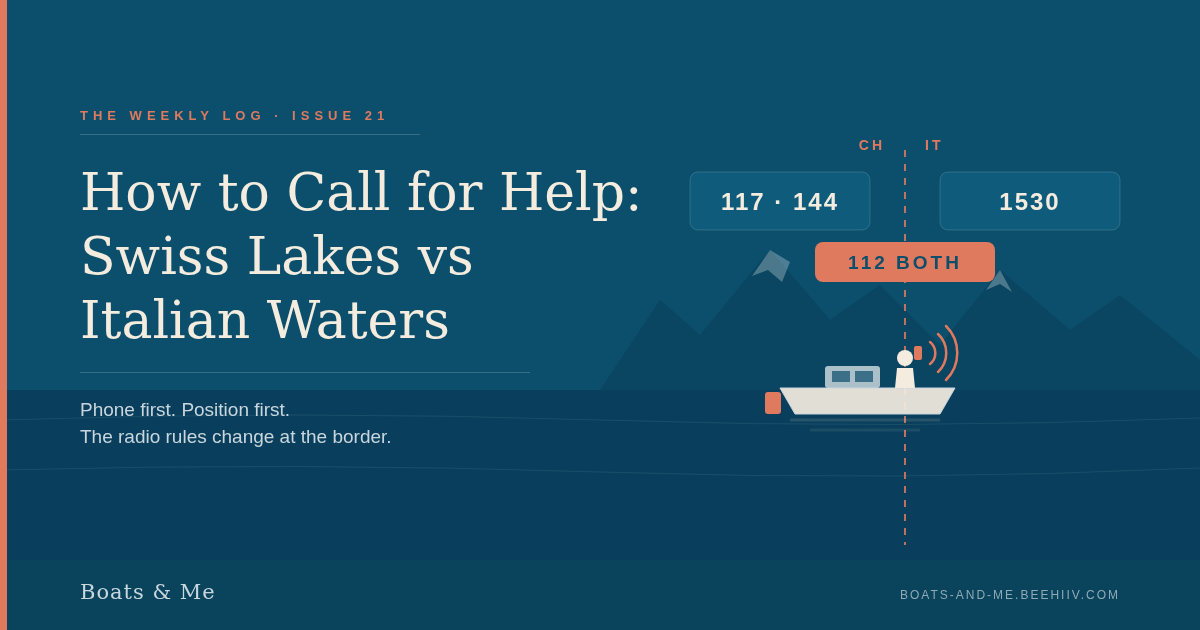
So what do most boaters on Ticino lakes actually rely on? A phone. In an emergency on the water, the cantonal police ask you to call 117. For a medical emergency, call 144. The European number 112 also works in Switzerland and is routed to the right service, though Swiss emergency organizations recommend the direct numbers.
Italian waters
In Italy, a VHF radio is mandatory on pleasure craft that go more than six nautical miles from the coast. If you use one, you need two things: a station license for the radio, and an operator certificate (the limited radiotelephone certificate, or the SRC for radios with DSC). One Italian guide states that even listening without them can be sanctioned.
Channel 16 is the international distress and calling channel. The Coast Guard monitors it around the clock, and boats under way are expected to keep their radio on and tuned to it.
If your radio has DSC, Italian guidance says you need a crew member holding an SRC certificate. Anyone aboard without one should not count on the red distress button. They should make a voice call on channel 16 or call 1530.
1530 is the Coast Guard emergency number for the sea, free and active 24 hours a day. 112 also works. On the three big lakes (Garda, Maggiore, Como), the Coast Guard runs its own units, coordinated from Milan, and tells lake users to call 112 or 1530 in an emergency.
One honest limit: whether the same radio license rules apply on Italian lakes as at sea is not something the available sources settle clearly. Ask the local port authority before you buy a radio.
What to say, on any phone or radio
The content of the call is the same everywhere. The BAKOM document for Lake Constance lays out the standard distress format: the word MAYDAY three times, "this is", and your boat's name three times. Then MAYDAY once more, your boat's name, your position, the nature of the emergency, the help you need, and anything else useful. Mayday is for immediate danger to a person or the boat, not for an engine that will not start on a calm day.
On a phone you skip the ritual and keep the order:
1. Where you are. Position first, because everything depends on it. Use the nearest town, landmarks, your navigation app, or What3Words (Issue 12). Say which lake and which side of the border.
2. Who you are. Boat name or description, and how many people are aboard.
3. What is wrong. Engine failure, taking on water, person overboard, injury.
4. What help you need. A tow, medical help, a rescue.
5. Stay on the line until you are told to hang up.
For a call to 1530 or 112 in Italian, this is the shape:
Siamo su una barca a motore sul Lago Maggiore, davanti a [località], lato italiano.
Abbiamo un'emergenza: [stiamo imbarcando acqua / il motore è in avaria e andiamo alla deriva / una persona è caduta in acqua].
Siamo in quattro a bordo, due sono bambini. Tutti indossano il giubbotto di salvataggio.
La nostra posizione è [coordinate o What3Words]. Restiamo in linea.
Before you need to call
Save the numbers in your phone and write them on a card on the boat: Switzerland 117, 144 and 112; Italy 1530 and 112. Know which country's waters you are in (Issue 15). Keep your phone in a waterproof case with a power bank (Issue 12). And tell someone on shore where you are going (Issue 6).
Swiss lakes also have an early warning system. The St. Gallen cantonal police describe strong-wind warning lights flashing 40 times a minute from force 6, and storm warning lights flashing 90 times a minute from force 8, with roughly an hour of lead time. Check how the system works on your own lake, and treat a flashing light as an instruction to head in.
A correction
In Issue 16, I wrote that you could call your marina on VHF channel 9 or 16 if conditions were too windy to dock. That advice does not hold on Swiss lakes, where standard marine VHF is not permitted, and I had not checked it for Italian waters either. Issue 16 has been corrected: call the marina by phone.
See you next Thursday.
— Ale
The radio rules change at the border. Standard marine VHF is not permitted on Swiss lakes. In Italy it is mandatory only beyond six nautical miles, and using one requires a license and an operator certificate.
On a lake, your phone is your main emergency tool: 117, 144 or 112 in Switzerland, 1530 or 112 in Italy.
Position first, then what is wrong, then what help you need.
The Swiss Federal Office of Communications publishes a short information sheet, "Funk- und Radaranlagen auf Schweizer Gewässern", on which radios are allowed on Swiss lakes and how channel 16 works. It is in German, and the edition behind this issue is dated 2021, so check bakom.admin.ch for the current one.
In Italy, the legal obligation applies beyond six nautical miles from the coast, so it is not the rule that governs a typical day on a lake. In Switzerland, a standard marine VHF cannot be used on lakes at all, though you can apply for a mobile land radio license if you want channel 16 on board. For most beginners on a lake, a charged phone in a waterproof case, a power bank, and the numbers in this issue are the realistic emergency kit. If you do buy a radio, sort out the license and operator certificate first.


